How to Ask for Speaker Testimonials the Right Way, Right After the Event
Get stronger speaker testimonials by asking organizers within 48 hours: two questions to ask, an email template, permission tips and where to use quotes.
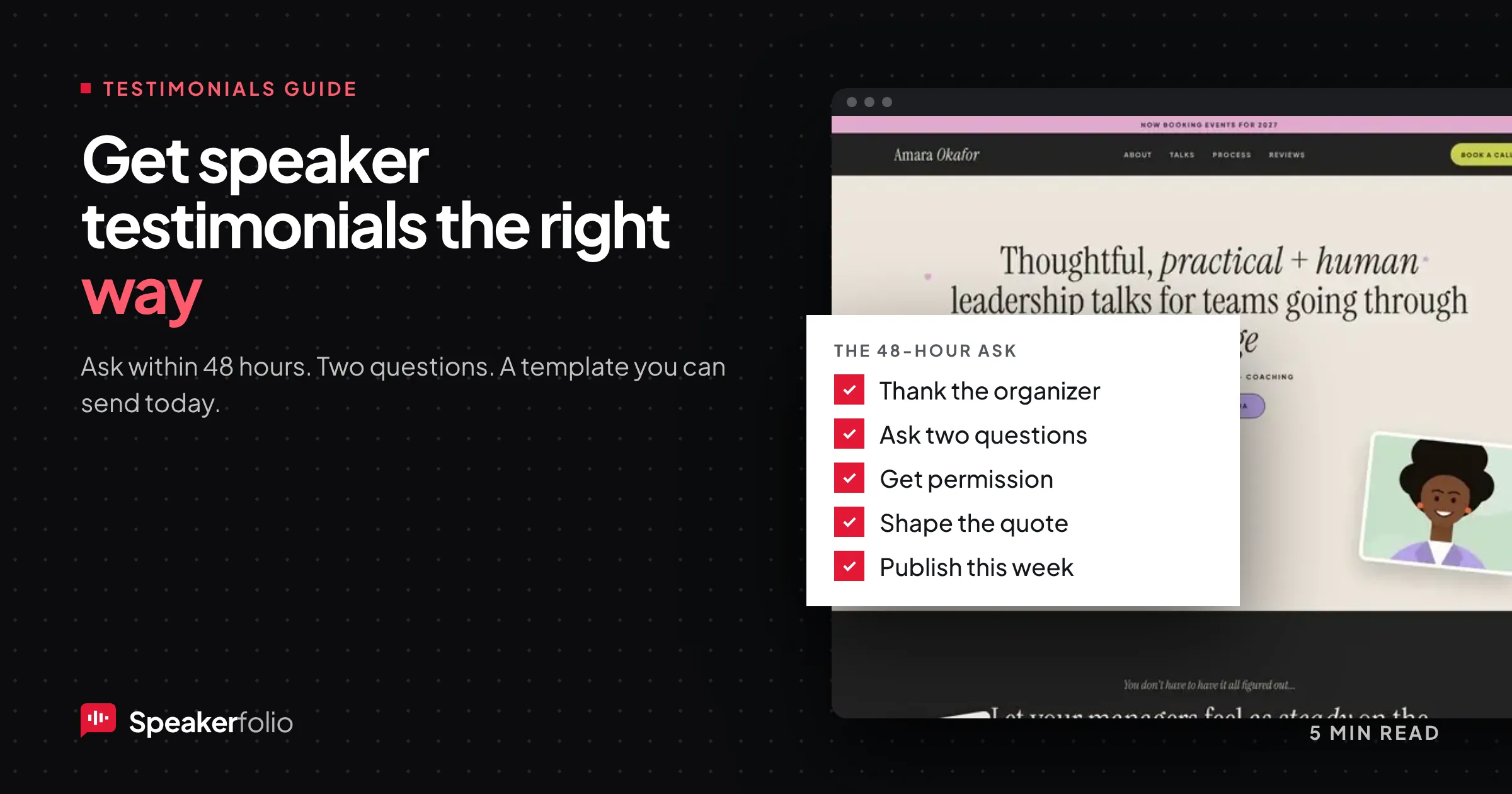
The best speaker testimonials come from the people who booked you, and they come quickly. Organizers are happiest with you the day after the event, while the feedback forms are still coming in. A week later they're planning the next one, and your request sits in their inbox.
This guide shows you when to ask, the two questions that get usable quotes, an email template you can copy, how to get permission and attribution right, and where to use testimonials so they help you get booked.
Why organizer testimonials matter most
Audience praise is nice. Praise from an organizer is what another planner trusts, because that person had the same job: they took a risk on a speaker, and it paid off.
A strong organizer testimonial answers the questions a planner can't answer from your video:
- Did the audience respond well?
- Was the speaker easy to work with?
- Would they book them again?
When to ask: within 48 hours
Timing does most of the work. Ask within two days of your talk, while the energy from the event is still fresh.
- Before the event: let the organizer know you'll ask for brief feedback afterwards. It makes the request expected, not awkward.
- Same day or next morning: send a thank-you note. Mention one specific moment from the event.
- Within 48 hours: ask for the testimonial, in the same email thread or a short follow-up.
- After a week: one polite reminder, then let it go.
The two-question method
Don't ask "Could you write a testimonial?". It sounds like homework, and you'll get a vague line like "Great speaker!". Ask two specific questions instead:
- "What did attendees say about the session?"
- "What would you tell another planner who's considering me?"
Their answers become the quote. The first gives you audience impact; the second gives you a recommendation in their own words.
Speaker testimonial request email template
Copy this, fill in the brackets and send it from your own email:
Subject: Thank you, and a quick question about [event name]
Hi [first name],
Thank you again for having me at [event name]. I loved [specific moment, e.g. the questions from your sales team at the end].
If you have two minutes, I'd value your answers to two quick questions:
- What did attendees say about the session?
- What would you tell another planner who's considering me?
With your permission, I'd like to share your answer on my website, with your name, role and organization. Just let me know if you'd prefer it anonymous.
Thanks again, [Your name]
Keep it short, specific and easy to answer from a phone.
Turn their answer into a strong testimonial
Organizers often reply with a few loose sentences. Shape them into one tight quote, then send it back for approval:
- Keep their words. Trim, don't rewrite.
- Keep the specific result. "Highest-rated session of the day" beats "really great".
- Add a line about working with you if they mentioned it: easy to work with, customized the talk, on time.
- Ask them to approve the final version before you publish it.
Weak vs strong speaker testimonials
| Weak testimonial | Strong testimonial |
|---|---|
| "Amazing speaker! Highly recommend." | "Our highest-rated session of the conference. Teams were still using her reset routine a month later." |
| Signed "J., HR" | Signed "Head of People, Northwind, Leadership Summit 2026" |
| About you as a person | About the audience and the result |
| No context | Event type and audience size included |
Get permission and attribution right
A quote signed "Head of People, Northwind, Leadership Summit 2026" carries far more weight than an anonymous one. Before you publish:
- Ask permission to use their name, role, organization and event.
- Ask about logos separately. Some organizations allow a quote but not their logo.
- Respect a request to stay anonymous. Use "Event organizer, financial services conference" instead.
- Keep a record of the email where they gave permission.
Ask for a short video testimonial
If the organizer is happy and you're still at the venue, ask for 20 seconds on your phone: "What would you tell another planner about this session?". A real organizer speaking on camera is one of the strongest pieces of proof you can have. Get their permission on the same clip.
Where to use your testimonials
- Your website: two or three on the home page, and the rest next to the talk they're about. Proof is one of the five sections every speaker website needs.
- Your speaker one-sheet: one or two short quotes under your talks.
- LinkedIn: ask the organizer to post it as a recommendation on your profile too.
- Emails to planners: one line from a similar event, in the first message.
- Your demo reel: a short text quote on screen, or the video testimonial at the end.
Use it the same week. Add the quote to your site straight away and keep the organization's logo for your client strip. On Speakerfolio, send it to us and we add it for you.
Common testimonial mistakes
- Waiting too long. After a week, response rates drop and the details fade.
- Asking for "a testimonial". Specific questions get specific answers.
- Editing words they didn't say. Trim, but keep it theirs, and get approval.
- Publishing without permission. It can damage a relationship you worked hard to build.
- Only using audience comments. Planners trust other planners more.
Frequently asked questions
When should a speaker ask for a testimonial?
Within 48 hours of the event. Organizers are most enthusiastic right after your talk, and the details are still fresh.
How do I ask an event organizer for a testimonial?
Thank them for the event, then ask two specific questions: what did attendees say about the session, and what would you tell another planner considering me? Ask permission to share the answer with their name.
What makes a good speaker testimonial?
A specific result, the person's name, role and organization, the event, and ideally a comment on what you were like to work with. Specific beats glowing.
Can I use a testimonial without the person's name?
Yes, if they prefer, but it carries less weight. Use a descriptive label such as "Event organizer, healthcare conference" instead of initials.
Where should speakers display testimonials?
On your website home page and next to each talk, on your speaker one-sheet, as LinkedIn recommendations, and in emails to planners.
Make proof part of every booking
Make asking for a testimonial a habit after every event: thank, ask two questions, get permission and publish within a week. After a few events, your proof section will do much of your selling for you.
Every Speakerfolio site has a testimonials section ready for organizer quotes. Get your free speaker website.

Saleh is a UI/UX and web designer with more than five years of experience and the founder of Speakerfolio, where he builds websites that help speakers get booked. He specialises in conversion-focused design and on-page SEO.
Connect on LinkedIn