How to Write a Speaker Bio Planners Can Actually Use (Templates and Examples)
Learn how to write a speaker bio event planners can paste straight into programs: three lengths, a simple formula, templates and examples to copy.
Planners paste your bio into programs, emails, event apps and the host's introduction. If they have to rewrite it, they will, and you lose control of how you're described. A good speaker bio is written for other people to use: short enough to fit, clear enough to read aloud, and specific enough to make an audience want to hear you.
This guide shows you how to write a speaker bio in three lengths, with a simple formula, templates you can fill in and examples you can adapt.
What a speaker bio is for
Your bio is not a CV. It's a tool for the people who book and introduce you:
- The planner pastes it into the event page and the program.
- The committee reads it to approve the booking.
- The host or emcee reads it out loud before you walk on stage.
- The marketing team uses a line of it in emails and social posts.
Each of them needs a different length, so you need more than one version.
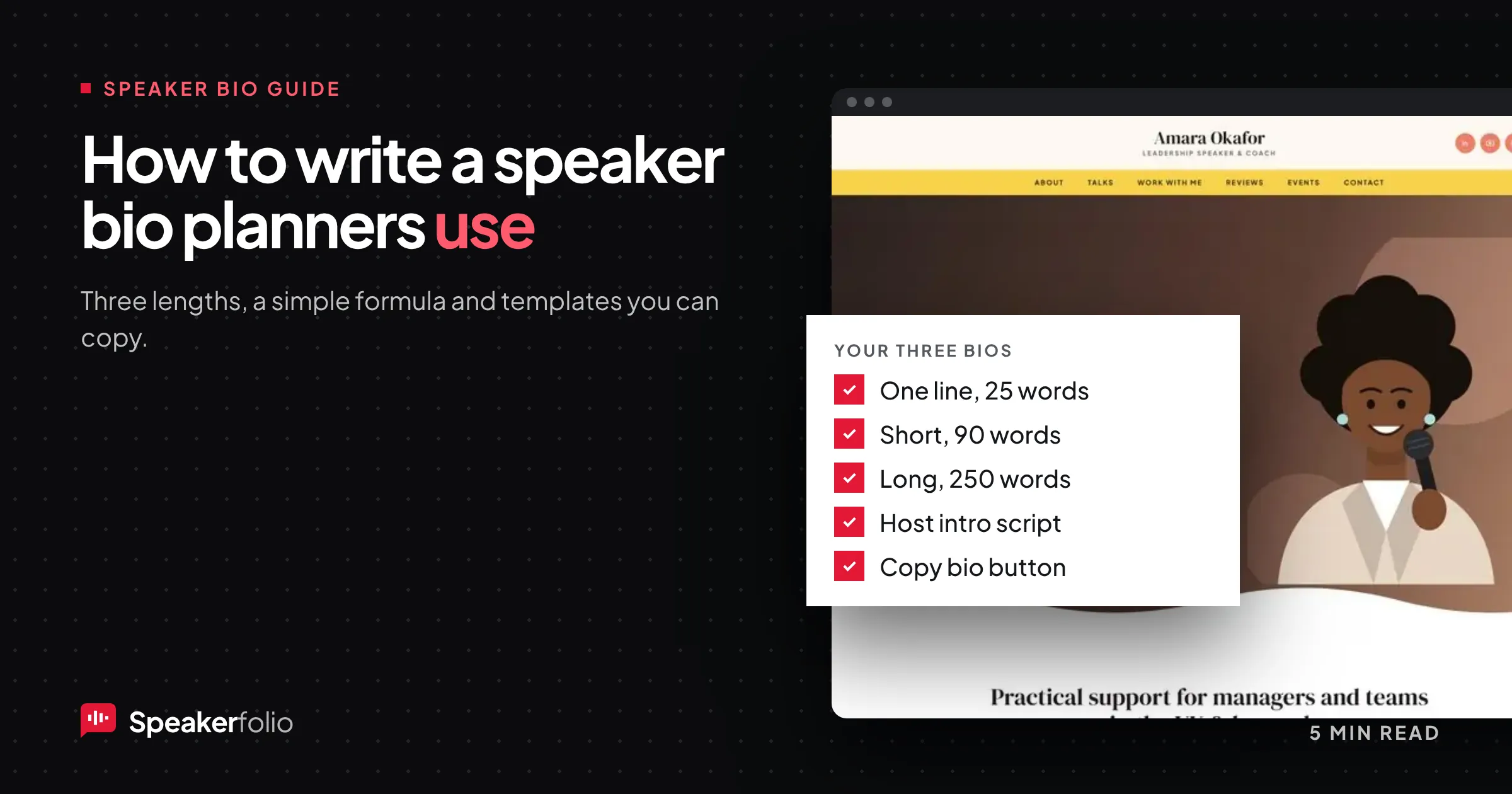
The three speaker bio lengths you need
| Version | Length | Where it's used |
|---|---|---|
| One-line bio | Under 25 words | Agendas, social posts, event apps |
| Short bio | About 80 to 100 words | Event pages, programs, speaker one-sheet |
| Long bio | About 200 to 300 words | Your website, media kit, press |
Write all three with the same facts at different depths. When a planner asks for "your bio", send the short one and link to the others.
The speaker bio formula
Every version follows the same four parts, in this order:
- Who you help and with what. Lead with your topic and audience, not your job title.
- Proof. The companies you've worked with, the book, a result, a credential that matters to your audience.
- Your story in one line. The experience that makes you worth hearing.
- Something human. Where you live, or what you do outside work. It gives the host something warm to say.
The one-line bio uses part 1 and a hint of part 2. The short bio uses all four briefly. The long bio expands each one.
Write in the third person
"Rina helps operations teams..." reads naturally when someone else says it out loud, and planners won't need to edit it. Keep a first-person version for your own About section if you like.
Lead with the outcome, not the history
Open with what you help audiences do, then the proof. Your early career can go last, or go. Compare:
- History first: "After graduating in 2004, Rina joined a logistics firm, where she spent ten years in various roles..."
- Outcome first: "Rina Akter helps operations teams cut wasted hours without burning people out."
The second one tells a planner in one sentence whether she fits their event.
Speaker bio templates
Copy these, fill in the brackets, then read each one out loud. If you stumble, shorten it.
One-line bio template
[Name] helps [audience] [achieve outcome] through [method or topic].
Example: Rina Akter helps operations teams cut wasted hours without burning people out.
Short bio template (about 90 words)
[Name] helps [audience] [outcome]. [He/She/They] [proof: worked with X, Y and Z / wrote [book] / led [result]]. [One line of story: what happened that makes this talk matter]. [Name]'s keynotes give audiences [two concrete takeaways]. [Human line: lives in [place], [one personal detail]].
Example: Rina Akter helps operations teams cut wasted hours without burning people out. She spent twelve years running warehouse and logistics teams through three company mergers, and now advises manufacturers and retailers on calmer, faster ways of working. Her keynote, Less Busy, More Done, gives audiences a one-page weekly plan and a meeting rule teams can start the next morning. She lives in Dhaka and has not missed a Friday cricket match in six years.
Long bio template (about 250 words)
Use the short bio as your first paragraph, then add:
- A paragraph of proof: organizations you've spoken for, results, awards, media, your book.
- A paragraph on your talks: the two or three topics you're booked for, and what audiences leave with.
- A closing line: how to book you, or where to learn more.
Write an introduction script for the host
Hosts often read your bio word for word, and long bios don't sound good spoken. Give them a separate introduction script of about 60 words, written to be said out loud:
Our next speaker has spent twelve years keeping warehouses running through three company mergers. Today she helps teams get more done with less stress. Please welcome Rina Akter.
Short sentences, no lists, and end on your name so the applause lands on cue. Planners appreciate it more than you'd expect.
Common speaker bio mistakes
- Too long. If a planner has to cut it, they'll cut the part you care about.
- A list of job titles. "Speaker, author, coach, consultant" tells nobody what you talk about.
- Vague claims. "World-class", "renowned" and "thought leader" add nothing. Use a fact instead.
- Out-of-date details. Old book titles or past roles make you look inactive.
- Inconsistent versions. If LinkedIn, your website and a bureau listing describe you differently, planners, search engines and AI tools get mixed messages.
Where to use your speaker bio
- Your website: the short bio on your home page with a Copy bio button, and the long bio on your About section. Every Speakerfolio site includes a Copy bio button so planners take the version they need in one click.
- Your speaker one-sheet: the short bio, next to your photo and talks.
- LinkedIn: the first lines of your About section should match your one-line bio.
- Speaker directories and bureaus: use the same short bio so your story is consistent everywhere.
Your bio is one of the sections every speaker website needs. For the full list, see the motivational speaker website checklist.
Frequently asked questions
How long should a speaker bio be?
Have three versions: a one-line bio under 25 words, a short bio of about 80 to 100 words, and a long bio of about 200 to 300 words. Send the short bio by default.
Should a speaker bio be in first or third person?
Third person. Planners and hosts use your bio to describe you, and "Rina helps teams..." reads naturally when someone else says it.
What should a speaker bio include?
Who you help and with what, proof such as clients, results or a book, one line of your story, and a human detail. Lead with the outcome for the audience, not your career history.
What's the difference between a speaker bio and an introduction?
A bio is written to be read, in programs and on websites. An introduction is a shorter script, about 60 words, written for the host to say out loud before you speak.
Where should I put my speaker bio online?
On your website with a copy button, at the top of your LinkedIn About section, on your speaker one-sheet and on every directory or bureau listing, using the same facts each time.
Make your bio easy to use
Write it once in three lengths, keep the facts the same everywhere, and make it easy to copy. Planners will use your words instead of their own.
Want it done for you? Speakerfolio writes your bio from your LinkedIn profile and puts it on a free speaker website with a Copy bio button. Get your free speaker website.

Saleh is a UI/UX and web designer with more than five years of experience and the founder of Speakerfolio, where he builds websites that help speakers get booked. He specialises in conversion-focused design and on-page SEO.
Connect on LinkedIn